[카테고리:] Living in Korea

Essential guide for travelers and expats in Korea

  • Google Cloud Platform Cost Optimization: 2026 Guide to Cutting Your GCP Bill

    Google Cloud Platform Cost Optimization: 2026 Guide to Cutting Your GCP Bill

    ⚠️ Pricing, discount programs, and tool availability change frequently. Always verify current rates and terms directly on Google Cloud’s official pricing and billing documentation before making budget decisions.

    Internal Google research found that among over-provisioned GCP workloads, 40% had provisioned 30 times the resources they actually needed — and 11% were over-provisioned by more than 100 times. If that number makes you wince, you’re not alone. Here’s a practical breakdown of where GCP costs actually come from, and the specific levers that make the biggest dent.

    ⚡ Quick Answer

    Use Spot VMs for fault-tolerant workloads (up to 91% savings), Committed Use Discounts for predictable baseline load, and right-size instances based on actual utilization — not projected peak traffic. Combine this with GCP’s free native tools (Recommender Hub, Billing Reports, budget alerts) before considering paid third-party FinOps platforms.

    1. Understand How You’re Actually Being Billed

    💡 The pricing fundamentals that shape every decision below

    📊 Usage-based by default — GCP bills per second for most services (one-minute minimum for Compute Engine), so your bill directly reflects workload behavior. Usage spikes mean cost spikes.
    🎁 Sustained use discounts (SUDs) — automatically applied when Compute Engine resources run more than 25% of a month, up to 30% discount, no commitment required.
    🔧 Unbundled pricing — GCP prices vCPUs and memory as separate SKUs, so custom machine types let you pay only for the exact combination your workload needs (at a roughly 5% premium versus predefined types).

    2. The Highest-Impact Quick Wins

    ActionPotential Savings
    Spot VMs / preemptible instancesUp to 91% for fault-tolerant workloads
    Removing idle/orphaned resourcesEliminates 100% cost on zero-value spend
    Right-sizing over-provisioned instancesOften 30-100x reduction where over-provisioning is severe
    Sustained use discountsUp to 30%, automatic, no commitment
    ⚠️ Spot VMs come with a real trade-off
    Google can reclaim Spot VM capacity with as little as 30 seconds’ warning. This pricing model is only appropriate for workloads that can tolerate interruption — batch processing, CI/CD pipelines, stateless services with retry logic. Don’t use Spot VMs for anything that can’t gracefully handle being killed mid-task.

    3. Committed Use Discounts: Know the Two Types

    💡 Resource-based vs. spend-based CUDs

    📦 Resource-based CUD — you commit to using a minimum amount of Compute Engine resources in a specific region for 1-3 years. CUD sharing lets you spread the discount across all projects under the same billing account.

    💵 Spend-based CUD — you commit to a minimum dollar-per-hour spend on a specific product, similar in concept to AWS Savings Plans. This creates predictable expenditure but risks committing to spend levels your team may not need a few months in.
    ⚠️ The lock-in risk is real
    Both CUD types risk committing you to resources or spend that may no longer be relevant to your business as it evolves. Before committing, model out your baseline usage over the actual commitment period (typically 1-3 years), not just current usage.

    4. GKE / Kubernetes-Specific Waste

    ⚠️ A surprisingly common and expensive blind spot
    Industry research indicates that up to 1 in 10 clusters across the entire GKE fleet runs completely idle at any given time. If you’re running Kubernetes on GCP, this alone is worth auditing — idle clusters accrue node costs with zero business value.
    ✅ GKE cost optimization checklist

    📉 Enable autoscaling with spot node pools for interruption-tolerant workloads
    🔍 Regularly audit for idle clusters and stale dev/test environments
    🏷️ Enforce strict labeling by namespace, deployment, or team — GKE cost allocation is notoriously difficult without this discipline, since costs are shared across nodes and workloads in ways native billing tools can’t easily attribute

    5. Cloud Run Billing: Choose the Right Mode

    Billing ModeBest For
    Request-based (default)Sporadic, bursty, or spiky traffic — you pay per request plus compute time during processing
    Instance-basedSteady, slowly varying traffic — no per-request fee, lower per-second rates; savings outweigh paying for idle time between requests
    ✅ Let Google tell you which one to use
    If you’re unsure, GCP’s built-in Recommender analyzes your Cloud Run service’s actual traffic over the past month and tells you whether switching billing modes would be cheaper. This is a genuinely underused free feature.

    6. Storage Costs: Lifecycle Policies Are Non-Negotiable

    💡 Storage class selection by access pattern

    🔵 Standard — frequent access
    🟢 Nearline — monthly access
    🟡 Coldline — quarterly access
    🔴 Archive — rarely touched data

    Cloud Storage lifecycle policies automatically transition data between these tiers based on age or access frequency, eliminating manual review cycles and preventing storage costs from spiraling as data volume grows exponentially.

    7. Native GCP Tools (Free, Use These First)

    ✅ Before paying for a third-party FinOps platform, exhaust these:

    📊 Cloud Billing Reports — track costs across projects, services, and resources
    🤖 Recommender Hub — machine learning-based recommendations for right-sizing, CUD opportunities, and idle resource identification
    📈 Cloud Monitoring — track utilization metrics to spot waste
    🧮 GCP Pricing Calculator — estimate costs before deploying
    🔔 Budgets and alerts — set spending thresholds with notifications (note: these alert you, they don’t act as a hard spending cap)
    ⚠️ The limitation of native tools
    These tools identify problems, but you still have to implement fixes manually. Native GCP labels also rarely provide the granularity finance and engineering teams need — mapping costs back to specific products, features, or customers typically requires either significant labeling discipline or a third-party cost intelligence layer.

    8. When to Consider a Third-Party FinOps Platform

    ✅ Signals it’s time to look beyond native tools

    🏢 Your team doesn’t have bandwidth for continuous manual optimization (quarterly reviews aren’t frequent enough — waste compounds daily)
    🔀 You run multi-cloud (AWS + Azure + GCP) and need unified visibility
    📊 You need per-customer unit economics rather than just aggregate spend
    🐳 Kubernetes cost allocation by namespace/deployment is a persistent pain point

    Look for platforms that deploy into your own GCP account (rather than requiring you to migrate) so you retain existing committed use discounts and startup credits.

    9. Common Mistakes to Avoid

    ⚠️ Watch out for these

    ❌ Sizing for peak traffic and never scaling back down — many workloads run 24/7 at peak-traffic sizing even when average utilization is 30-40%
    ❌ Treating quarterly cost reviews as sufficient — waste compounds continuously; effective optimization happens through automation, not periodic manual audits
    ❌ Committing to spend-based CUDs without modeling multi-year usage trends
    ❌ Ignoring orphaned resources — unused disks, snapshots, and static IPs continue billing indefinitely until manually deleted
    ❌ Using Spot VMs for workloads that can’t tolerate interruption

    Frequently Asked Questions

    Q: What’s the single fastest win for reducing my GCP bill?
    Auditing for idle and orphaned resources (unused disks, static IPs, idle GKE clusters, stale dev/test environments) typically delivers the fastest, most straightforward savings since you’re eliminating pure waste rather than trading off performance.

    Q: Are Sustained Use Discounts and Committed Use Discounts the same thing?
    No. SUDs apply automatically with no commitment once you cross a usage threshold (25%+ of the month) and cap around 30%. CUDs require an upfront 1-3 year commitment in exchange for deeper, more predictable discounts, but come with lock-in risk.

    Q: Do I need a third-party tool, or are Google’s native tools enough?
    For smaller teams or simpler infrastructure, native tools (Recommender Hub, Billing Reports, budget alerts) are often sufficient. Complex multi-cloud setups, heavy Kubernetes usage, or a need for per-customer cost attribution are the strongest signals that a third-party FinOps platform is worth the investment.
  • 단백질 음료 매일 마셔도 될까: 건강·편의성 장단점과 제품 고르는 법

    단백질 음료 매일 마셔도 될까: 건강·편의성 장단점과 제품 고르는 법

    ⚠️ 이 글은 단백질 음료에 대한 일반적인 정보 제공 목적으로 작성되었으며, 의학적 진단이나 치료를 대체할 수 없습니다. 신장질환, 간질환 등 기저질환이 있거나 특정 식이 제한이 필요한 경우, 섭취 전 반드시 의사 또는 영양사와 상담하시기 바랍니다.
    단백질 음료 프로틴 쉐이크 건강 편의성

    편의점 냉장고에 자리 잡은 단백질 음료, 매일 마셔도 될까요 ⓒ Unsplash

    요즘 편의점, 마트 어디를 가도 단백질 음료가 가득합니다. 운동하는 사람들의 전유물이었던 프로틴이 이제는 아침 대용, 다이어트 보조식으로 일상 깊숙이 들어왔습니다. 그런데 정말 매일 마셔도 괜찮은 걸까요? 오늘은 단백질 음료의 건강 측면과 편리함 측면의 장단점을 나눠서 살펴보고, 제품 고르는 법과 주의사항까지 정리했습니다.

    1. 단백질 음료, 왜 이렇게 인기일까

    💡 단백질 음료가 확산된 배경

    단백질은 근육뿐 아니라 장기, 피부, 모발, 호르몬과 면역물질 조절에도 꼭 필요한 영양소입니다. 하지만 닭가슴살, 계란, 살코기 등 일반 식품으로 매끼 충분한 단백질을 챙기기는 현실적으로 어렵습니다. 특히 혼자 사는 직장인이라면 식단 관리 자체가 부담이죠. 이 틈을 파고든 것이 간편하게 마실 수 있는 단백질 음료입니다.

    2. 건강 측면 — 장점과 단점

    ✅ 건강 장점

    🥩 근육 합성·유지 지원 — 운동 후 단백질 섭취는 근육 회복에 도움

    🍽️ 포만감 유지 — 다이어트 중 공복감을 줄이는 데 활용 가능

    🧬 필수아미노산 보충 — 일부 제품은 아미노산스코어가 높아 균형 잡힌 단백질 공급

    ⚠️ 건강 단점

    🤢 소화기 문제 — 유당불내증·우유 알레르기 있는 경우 복통·설사 유발 가능

    🔴 피부 트러블 — 유청단백질의 IGF-1 성분이 피지 분비를 자극해 여드름 유발 가능

    🍬 당분·칼로리 과다 — 일부 제품은 당류 함량이 높아 오히려 체중 증가 요인

    🚨 장기 과다 섭취 시 위험
    장기간 고단백 식단을 지속하면 신장 기능에 부담을 줄 수 있다는 연구들이 있습니다. 특히 기존에 신장질환이 있는 경우 단백질 과다 섭취는 상태를 악화시킬 수 있어 각별한 주의가 필요합니다. 뼈와 칼슘 대사, 간 기능에도 영향을 줄 수 있다는 지적이 있으니, 무조건 많이 마신다고 좋은 것이 아닙니다.

    3. 편리함 측면 — 장점과 단점

    ✅ 편리함 장점

    🎒 휴대성 최강 — 상온 보관 가능, 가방에 넣고 다녀도 상할 걱정 없음

    ⏱️ 조리 시간 제로 — 뚜껑만 열면 바로 섭취 가능

    🏢 사회적 부담 없음 — 회사에서 도시락처럼 냄새나 눈치 걱정 없이 섭취 가능

    ⚠️ 편리함 단점

    💸 일반 식품 대비 비용 높음 — 같은 단백질량을 식품으로 섭취하는 것보다 비쌈

    🍗 포만감·만족감 부족 — 액체 형태라 씹는 즐거움이나 실제 식사 만족감은 낮음

    📋 정확한 섭취 가이드 부족 — 음료형 제품은 1회 권장 섭취량 안내가 없는 경우가 많음

    4. 제품 고를 때 확인해야 할 것 — 실제 소비자원 조사 결과

    한국소비자원이 시중 단백질 제품 16개(분말형 8개, 음료형 8개)를 조사한 결과, 제품 간 편차가 예상보다 컸습니다.

    항목조사 결과
    단백질 함량제품당 4~29g으로 최대 7.3배 차이
    아미노산스코어45~141로 편차 큼 (85 이상이 건강기능식품 기준)
    식물성 단백질 음료지방·열량은 낮지만 일부 아미노산 부족으로 스코어 낮은 경향
    안전성조사 대상 전 제품에서 이물, 미생물, 중금속 등 기준치 이하로 안전
    ✅ 제품 선택 시 꼭 확인할 것

    📊 영양성분표의 단백질 함량(g) — 제품마다 차이가 크니 반드시 비교
    🍬 당류 함량 — 1회 섭취량 기준 당류 몇 g인지 확인
    🥛 동물성 vs 식물성 — 유당불내증이 있다면 식물성(대두·완두 등) 제품 고려
    🔬 아미노산스코어 표기 여부 — 표기된 제품이 상대적으로 신뢰도 높음
    🎯 섭취 목적에 맞는 제품 — 근육 증량용/체중 관리용/일반 보충용에 따라 성분 다름

    5. 동물성 vs 식물성 단백질 — 뭐가 나에게 맞을까

    구분특징추천 대상
    웨이(유청) 단백질흡수 빠름, 필수아미노산 균형 좋음운동 직후 빠른 보충 원하는 경우
    카제인 단백질천천히 흡수(약 8시간), 물에 잘 안 녹음취침 전, 야간 근손실 방지 목적
    소이(대두) 단백질지방·콜레스테롤 적음, 이소플라본 함유유당불내증, 채식 지향자

    6. 이렇게 마시면 좋습니다 — 건강한 섭취 습관

    ✅ 단백질 음료 건강하게 섭취하는 법

    ⏰ 한 번에 몰아 마시지 않기 — 하루 필요량을 여러 번 나눠 섭취하면 소화기 부담 감소
    🍽️ 일반 식품과 병행 — 음료는 보조 수단으로, 주된 단백질은 실제 식품에서 섭취
    💧 충분한 수분 섭취 — 고단백 섭취 시 수분을 함께 충분히 마셔야 신장 부담 완화
    📅 매일 습관적으로 마시기보다 필요할 때 — 운동 강도가 낮은 날까지 무조건 챙길 필요는 없음
    ⚠️ 이런 분은 섭취 전 반드시 상담하세요
    신장질환, 간질환이 있는 분, 통풍이 있는 분, 특정 알레르기가 있는 분은 단백질 음료 섭취 전 반드시 의사나 영양사와 상담하시기 바랍니다. “몸에 좋다니까”라는 이유만으로 무분별하게 섭취하는 것은 위험할 수 있습니다.

    7. 결론 — 마시는 약이 아니라 보조식품입니다

    단백질 음료는 분명 편리하고, 적절히 활용하면 도움이 되는 제품입니다. 하지만 “마시기만 하면 살이 빠지거나 근육이 붙는” 마법의 음료는 아닙니다. 일반 식사를 대체하기보다 부족한 부분을 보완하는 용도로 활용하고, 제품마다 단백질 함량과 당류 편차가 크다는 점을 기억해 꼼꼼히 비교해서 고르시길 바랍니다.

    자주 묻는 질문 (FAQ)

    Q. 운동을 안 하는 사람도 단백질 음료를 마셔도 되나요?
    가능합니다. 다만 운동을 하지 않는다면 근육 합성을 위한 다량의 단백질이 필요하지 않으므로, 평소 식단에서 단백질이 부족하다고 느낄 때 보조적으로만 섭취하는 것을 권장합니다.

    Q. 다이어트 중 식사 대신 단백질 음료만 마셔도 되나요?
    단기간 포만감 유지에는 도움이 될 수 있지만, 장기간 식사를 대체하는 것은 다른 영양소 결핍으로 이어질 수 있어 권장하지 않습니다. 균형 잡힌 식사와 함께 보조적으로 활용하세요.

    Q. 단백질 음료를 마시면 살이 찌나요?
    제품에 따라 다릅니다. 당류와 칼로리가 높은 제품을 과다 섭취하면 오히려 체중 증가로 이어질 수 있으니, 영양성분표를 꼭 확인하고 본인의 하루 총 칼로리 안에서 섭취하는 것이 중요합니다.

    Q. 하루에 몇 개까지 마셔도 안전한가요?
    개인의 체중, 활동량, 기존 식단의 단백질 섭취량에 따라 다르므로 일률적으로 답하기 어렵습니다. 일반적으로 체중 1kg당 단백질 0.8~1.6g이 권장되는 범위로 알려져 있으니, 이를 기준으로 전체 식단과 함께 계산해보는 것이 좋습니다. 정확한 개인별 권장량은 영양사와 상담하시는 것을 추천합니다.

    다른 생활·재테크 정리 글은 시리즈 목차에서 주제별로 보실 수 있습니다.

  • 2026 K-ETA & e-Arrival Card Guide: Mandatory Entry Steps for Korea

    2026 K-ETA & e-Arrival Card Guide: Mandatory Entry Steps for Korea

    1. Understanding the K-ETA (Electronic Travel Authorization)

    The K-ETA is an electronic travel authorization that visa-free visitors must obtain before entering Korea. It’s not a visa, but it acts as a pre-screening tool for immigration.

    • Who needs it? Citizens of countries under the visa-waiver agreement.
    • When to apply? At least 72 hours before your flight.
    • Validity: Generally valid for two years, allowing multiple entries.
    K-ETA 공식 홈페이지 메인 화면 스크린샷

    Crucial Tip: Some nationalities are currently exempt from K-ETA. Before you spend time applying, check the official website to ensure your passport requires it. Applying unnecessarily can lead to delays or confusion at the border.

    2. Mastering the Mandatory e-Arrival Card

    In 2026, the e-Arrival Card is a mandatory step for all travelers. While you can technically fill it out upon arrival, doing so at the airport often leads to long queues and unnecessary stress.

    Why submit it early? If you submit the form online before you leave your home country, you will receive a QR code. At immigration, simply show this QR code to the immigration officer, and you’ll skip the time-consuming data entry process.

     e-Arrival Card 완료 후 생성되는 QR 코드 예시

    3. Detailed Step-by-Step Entry Checklist

    Follow these steps to ensure you don’t face any issues at Incheon or Gimpo Airport:

    1. Verification: Double-check your passport expiration date. Korea generally requires at least 6 months of validity.
    2. K-ETA Submission: Upload a clear, high-quality passport photo. The system is very sensitive; a blurry photo is the #1 cause of rejection.
    3. Accommodation Details: Have your hotel name and contact number ready. If staying with a friend, ensure you have their full Korean address.
    4. e-Arrival Card QR: Once the form is complete, take a screenshot of the final QR code to your phone’s gallery. Do not rely on email access while offline at the airport.

    4. Common Mistakes to Avoid

    Most travelers get flagged or delayed due to minor clerical errors. Ensure your passport number is exact, and confirm that your name matches the machine-readable zone at the bottom of your passport exactly.

    5. Are You Actually Exempt? (2026 Update)

    Before you spend money and time on an application, check this: Korea has extended its temporary K-ETA exemption through December 31, 2026.

    Nationals of the countries and regions on the exemption list — which includes the United States, Canada, and many European nations — do not need a K-ETA to enter Korea during this period. The Ministry of Justice extended the measure to simplify entry and support inbound tourism.

    A useful detail: if you start an application and scan your passport information page, the system shows a pop-up telling you that you are exempt. So even if you are unsure, the application itself will tell you before you pay.

    ⚠️ This is a temporary measure that has been extended more than once. Always confirm the current status on the official K-ETA website before you travel — policy here changes more often than most entry requirements.

    6. The Exemption Trade-Off Most Travelers Miss

    Here is the part that is genuinely counterintuitive: being exempt does not mean applying is pointless.

    If you hold an approved K-ETA, you are not required to submit an arrival card — neither the paper form nor the e-Arrival Card. If you travel exempt, you still have to complete the arrival card.

    Your choiceK-ETA feeArrival cardBest for
    Travel exemptNoneRequiredOne-off trip; happy to fill in the card
    Apply anywayFee appliesNot requiredFrequent visitors; want the smoothest arrival

    Since an approved K-ETA is generally valid for around two years with multiple entries, travelers who come to Korea more than once in that window often find it worth applying even while exempt. If this is a single holiday, skipping it and filling in the card is perfectly reasonable.

    7. Timing: When to Do Each Step

    The most common problem is not eligibility — it is leaving things to the last day. A rough schedule:

    • 2–4 weeks before departure — Check whether your nationality is exempt. If you decide to apply for K-ETA, do it now.
    • At least 72 hours before your flight — This is the minimum lead time for a K-ETA application. Most approvals come faster, but some go to manual review and take considerably longer.
    • Within 3 days before arrival — The e-Arrival Card can be submitted online in this window. Doing it in advance saves you filling in a paper form on the plane or queueing at a kiosk.
    • On arrival — Have your passport, your accommodation address, and your return flight details ready. These are the things immigration actually asks about.

    One practical note: write down your first night’s accommodation address before you fly. Both the arrival card and immigration officers ask for it, and searching for a booking confirmation on airport Wi-Fi with a queue behind you is not fun.

    8. What Actually Causes Problems at Immigration

    Refusals are rare for tourists, but delays are not. These are the recurring causes:

    • Name mismatch — The name on your K-ETA or arrival card must match your passport exactly, including middle names. A shortened first name is enough to cause a manual check.
    • Passport validity — Six months of remaining validity is the standard expectation. Check this early; renewals take weeks.
    • No onward ticket — Officers may ask for proof you are leaving. Have a return or onward booking accessible offline.
    • Vague answers about your stay — “Just travelling around” with no address invites follow-up questions. A concrete first-night address resolves it immediately.
    • Assuming an old approval still applies — A K-ETA tied to an expired passport does not carry over to a new one. If you renewed your passport, you need to reapply.

    None of this is difficult — it just needs to be handled before you are standing in the arrivals hall. Sort the paperwork at home and Korean immigration is genuinely one of the faster ones to get through.

    Conclusion

    Preparation is the key to a smooth start to your Korean journey. By completing your K-ETA and e-Arrival Card at least three days before your departure, you’ll trade long, frustrating lines for a fast track through immigration.

    (https://kettletune.com/how-to-use-kakao-t-korea-guide)] (추천 멘트: 이제 입국 완료했지? 공항에서 시내로 나갈 때 꼭 필요한 카카오T 사용법은 여기서 확인해 봐!)

    Have questions about the application or ran into a specific error message? Share it in the comments below—I’m here to help you get your travel plans sorted!

    Related Reads

  • How to Use Kakao T Like a Local in Korea: The Ultimate Navigation Guide for Tourists

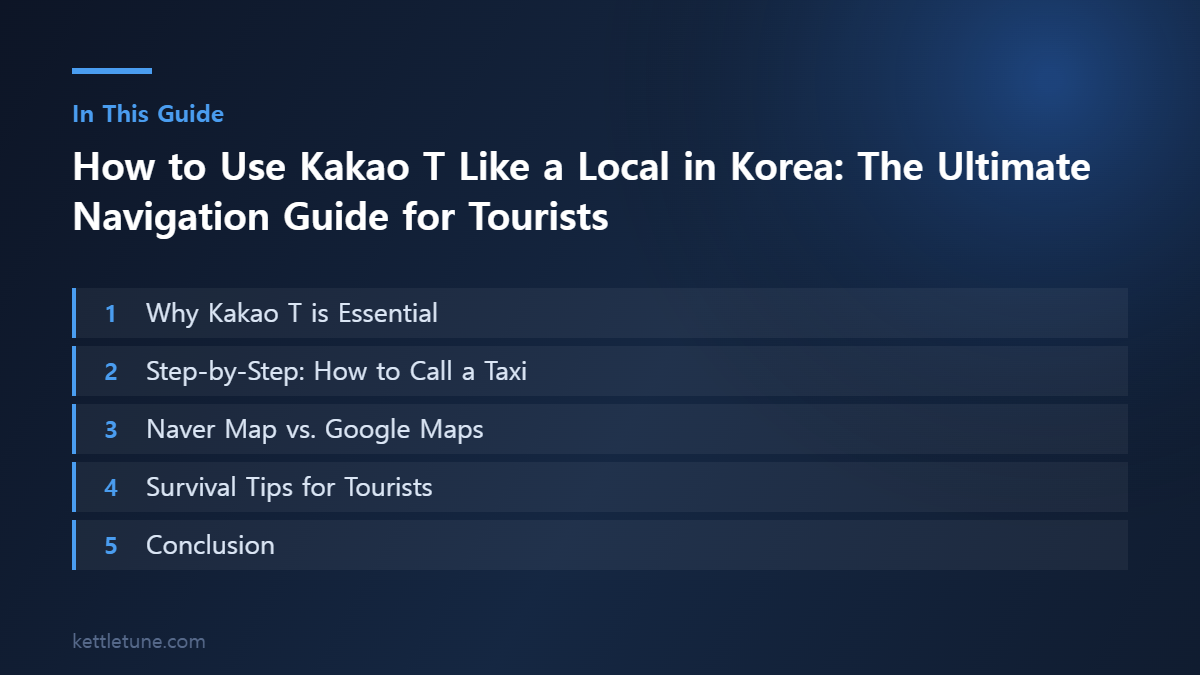
    How to Use Kakao T Like a Local in Korea: The Ultimate Navigation Guide for Tourists

    If you are planning your first trip to Korea, you might be worried about how to get around. You might have heard that Google Maps isn’t as reliable here as it is in other countries. Don’t worry! In this guide, I’ll show you the exact apps you need to navigate Korea like a local.

    How to Use Kakao T Like a Local in Korea: The Ultimate Navig 핵심 흐름 요약: Why Kakao T is Essential, Step-by-Step: How to Call a Taxi, Naver Map vs. Google Maps

    💡 Why Kakao T is Essential

    Kakao T is the “Uber of Korea.” Whether you need a taxi, a designated driver, or even parking, this app does it all. For tourists, the biggest advantage is that you don’t need to speak Korean to call a taxi. Simply type in your destination in the app, and the driver receives your exact location.

    • Pro Tip: You can link your international credit card directly to the app, so you don’t have to worry about cash or payment issues at the end of your ride.

    🚕 Step-by-Step: How to Call a Taxi

    1. Download & Register: Search for “Kakao T” on the App Store or Google Play. Sign up using your phone number.
    2. Select ‘Taxi’: Tap the Taxi icon on the main screen.
    3. Set Your Destination: Type your destination in English or Korean.
    4. Call: Choose the type of taxi and hit “Call.” You will see the driver’s car model and license plate number.

    🗺️ Naver Map vs. Google Maps

    If you try to use Google Maps in Korea, you will quickly notice it doesn’t show walking routes or public transport directions accurately. This is due to Korean security regulations.

    • The Winner: Naver Map or Kakao Map.
    • Key Advantage: Both apps have an English interface and provide real-time bus/subway info, including the fastest transfer cars.

    ✈️ Survival Tips for Tourists

    Offline Maps: Download your route on Naver Map before you leave your hotel so you don’t get lost even with weak data.

    • Airport Taxi: Look for official “International Taxi” signs at Incheon Airport, or just use Kakao T, which works perfectly.
    • Communication: Don’t worry about phone calls! Most drivers will understand if you show them the destination screen on your app.

    💳 The Payment Problem (Read This First)

    This is the single biggest thing that trips up visitors, and most guides skip it. Registering a foreign-issued credit card for automatic in-app payment often fails.

    Kakao T does have a Non-Korean Credit Card option under My Info → Payment Method, so it is worth trying. But the domestic payment gateway frequently rejects overseas Visa and Mastercard registrations. Whether it works depends on your card issuer, the country it was issued in, and sometimes just timing — so failures are common and not something you did wrong.

    The reliable workaround: on the payment screen, choose “Pay directly” / “Pay to the driver.” The app then stops asking you to register a card, and you settle the metered fare when you get out.

    • Cash (Korean won) — the surest option. Always works.
    • Physical overseas credit card — usually fine, but some terminals or issuers decline it.
    • T-money transit card — works in most taxis and is easy to top up at any convenience store.

    Practical advice: carry ₩30,000–50,000 in cash even if you plan to pay by card. One declined terminal at 1 a.m. is enough to ruin a night.

    🚖 Which Kakao T Taxi Type Should You Pick?

    When you call a ride you will see several tiers. They are not just cosmetic — prices differ significantly.

    TypeWhat it isWhen it makes sense
    일반 (Regular)Standard metered taxiDefault choice. Cheapest.
    블루 (Blue)Vetted drivers, guaranteed dispatchRush hour, or when regular taxis are not accepting
    벤티 (Venti)Large van, up to 6 passengersGroups, or lots of luggage
    블랙 (Black)Premium sedanBusiness travel. Considerably more expensive.

    During peak hours regular taxis may not accept your call at all. That is when Blue becomes worth the extra fee — it guarantees a dispatch. Outside rush hour, Regular is almost always fine.

    ✅ Mistakes First-Time Users Make

    • Typing the English address — Korean addresses often do not match well in English. Search by building name, station name, or the Korean name instead. Copying a Korean address from Naver Map and pasting it works best.
    • Not adjusting the pickup pin — the app guesses your location from GPS, which drifts badly in dense areas and underground. Drag the pin to a spot the driver can actually stop at.
    • Standing on the wrong side of the road — many Seoul roads have medians the driver cannot cross. Check which direction the car is coming from.
    • Ignoring the late-night surcharge — fares increase after midnight. The meter is correct; it is not a scam.
    • Expecting the driver to speak English — most do not. Having your destination on screen in Korean solves this entirely, which is exactly what the app is for.

    🌏 Alternatives Worth Knowing

    Kakao T is dominant, but it is not your only option.

    • k.ride — built specifically for international travelers. You can sign up with a Google or Apple account, it accepts foreign cards for in-app payment, and it offers translation in a wide range of languages. Fewer drivers than Kakao T, but it solves the payment issue.
    • Uber — operates in Korea, though coverage and pricing vary and it is often more expensive than a regular Kakao T taxi.
    • Subway and buses — genuinely excellent in Seoul and most major cities, and dramatically cheaper. A T-money card covers both. For most daytime trips within Seoul, the subway is faster than a taxi.

    A reasonable setup for a first trip: use the subway as your default, keep Kakao T for late nights, awkward routes, and luggage days, and carry a T-money card plus some cash. That combination covers almost every situation without any registration headaches.

    Conclusion

    Korea is one of the most convenient countries to travel around if you have the right apps. Download Kakao T for taxis and Naver Map for directions, and you’re all set!

    Do you have any other questions about traveling to Korea? Leave a comment below!

    Related Reads

  • Excel for Office Workers Part 1: Master Pivot Tables & VLOOKUP to Analyze Raw Data in 5 Minutes

    Excel for Office Workers Part 1: Master Pivot Tables & VLOOKUP to Analyze Raw Data in 5 Minutes

    Excel raw data analysis

    Massive datasets don’t have to mean overtime ⓒ Unsplash

    📊 [Excel & PowerPoint for Office Workers Series] Part 1
    Learn to analyze massive raw data in 5 minutes using Pivot Tables and VLOOKUP.

    Ever received a spreadsheet with tens of thousands of rows and felt your stomach drop? Manually hunting for matching data across departments, months, and sheets is a fast track to unpaid overtime. But here’s the truth: real-world Excel work isn’t a function-memorization contest. Two tools — VLOOKUP and Pivot Tables — are enough to turn a data nightmare into a 5-minute task. Let’s break them down.

    1. Real-World Excel Isn’t About Memorizing Functions

    Excel courses often throw dozens of functions at you. In practice, though, the functions you use daily are a short list. What actually matters isn’t how many functions you know — it’s how efficiently you structure and clean your data before analysis.

    💡 The Reality of the Job
    What determines when you go home isn’t “how many functions do I know” — it’s “how fast can I turn raw data into the shape I need.” VLOOKUP and Pivot Tables are your two core weapons for that.

    2. VLOOKUP: The Magic That Merges Scattered Data

    VLOOKUP function merging data sheets

    VLOOKUP is the bridge between separate sheets ⓒ Unsplash

    Data at work is never neatly sitting in one sheet. Employee IDs live in HR’s sheet, sales numbers in Sales’ sheet, department info in yet another sheet. VLOOKUP merges them into a single table using a common key value (like an ID or code).

    =VLOOKUP(lookup_value, table_array, col_index_num, 0)
    ✅ Basic VLOOKUP Usage

    📌 lookup_value — the value you’re searching for (e.g., employee ID)
    📌 table_array — the full range containing that value
    📌 col_index_num — which column of the range to pull the result from
    📌 0 (or FALSE) — exact match only

    Example: pulling a department name from another sheet using employee ID
    =VLOOKUP(A2, HR_Sheet!A:D, 3, 0)

    The #1 Real-World Mistake — Forgetting Absolute References ($)

    ⚠️ This Is Why You End Up Working Late

    When you drag a VLOOKUP formula down, the “range” argument shifts with it — pulling in the wrong data entirely. The fix is an absolute reference, marked with $.

    ❌ =VLOOKUP(A2, HR_Sheet!A:D, 3, 0) → range shifts when dragged
    ✅ =VLOOKUP(A2, HR_Sheet!$A:$D, 3, 0) → range stays locked

    💡 Pro tip: select the range in your formula and press F4 to auto-insert the $ symbols.

    Fixing #N/A Errors

    CauseFix
    Extra spaces or typos in lookup valueUse TRIM to strip whitespace, then retry
    Value doesn’t actually exist in the rangeConfirm the value truly exists in the source data
    Text vs. number format mismatchUse VALUE or TEXT to standardize formats
    Want to hide the #N/A visuallyWrap it: =IFERROR(VLOOKUP(...), "N/A")

    3. Pivot Tables: Turn Data Into Insights in 60 Seconds

    Once VLOOKUP has merged your data into one table, it’s time to turn it into something a manager actually wants to see. That’s where Pivot Tables shine — a few clicks and drags summarize your data by month, department, or product automatically.

    ✅ Building a Pivot Table Step by Step

    1️⃣ Select your data range → Insert → PivotTable
    2️⃣ Drag your grouping field (e.g., Department, Month) into Rows
    3️⃣ Drag your numeric field (e.g., Revenue, Quantity) into Values
    4️⃣ You now have an automatic summary table
    5️⃣ Click a value cell → “Value Field Settings” to switch between Sum/Average/Count

    💡 “What’s total revenue by department this month?” becomes three drags, not an afternoon.

    Real-World Pivot Table Scenarios

    ScenarioPivot Table Setup
    Track monthly revenue trendsRows: Month / Values: Sum of Revenue
    Headcount by departmentRows: Department / Values: Count of Employee ID
    Compare products across regionsRows: Product / Columns: Region / Values: Sum of Units Sold
    Defect rate analysis by equipmentRows: Equipment Name / Values: Sum of Defects, Sum of Output

    4. Conclusion: When Excel Gets Easier, You Get More Time to Actually Think

    Once VLOOKUP and Pivot Tables become second nature, the time you used to spend wrangling data drops dramatically. That freed-up time is the time you spend on what actually matters: interpreting data and planning the next move. Don’t stay trapped in data cleanup — the real value comes after.

    📊 Coming Up Next (Part 2)
    How to use ChatGPT to write Excel macros (VBA) without knowing how to code, and automate repetitive tasks.

    Frequently Asked Questions

    Q. Should I use XLOOKUP instead of VLOOKUP?
    XLOOKUP (available in Excel 365) is more flexible and powerful. But if your workplace uses an older Excel version, VLOOKUP remains the standard. It’s worth knowing both.

    Q. How do I do a VLOOKUP with multiple conditions?
    VLOOKUP natively only supports single-condition lookups. For multiple conditions, create a helper column that concatenates your criteria (e.g., Department & ProductCode), or use INDEX+MATCH, or XLOOKUP if available.

    Q. My Pivot Table isn’t updating after I changed the source data.
    Pivot Tables don’t auto-refresh. Right-click inside the Pivot Table and select “Refresh” after any change to the source data.

    Related Reads

  • Ride-Hailing Apps Around the World: Your Complete Guide to Bolt, Grab, and Getting Around Like a Local

    Ride-Hailing Apps Around the World: Your Complete Guide to Bolt, Grab, and Getting Around Like a Local

    city transport ride hailing travel guide

    Getting around like a local starts with knowing which app to open ⓒ Unsplash

    There’s a particular kind of travel frustration that hits the moment you land in an unfamiliar city and realize you have no idea how to get from the airport to your hotel without getting taken advantage of. Unofficial taxis, fixed-price “tourist rates,” and drivers who conveniently don’t have change — it’s a story every seasoned traveler has lived at least once.

    The good news is that ride-hailing apps have fundamentally changed this equation. When used correctly, they eliminate price negotiation, provide route transparency, offer driver accountability, and give you a digital record of every trip. But they only work when you know which app to use where, and what the local quirks are — which is exactly what this guide covers.

    1. Budapest, Hungary: Why Bolt Is the Only Answer

    Budapest city transport guide

    Budapest’s transport mix rewards the prepared traveler ⓒ Unsplash

    🟡 App to Use: Bolt (formerly Taxify)

    Bolt is an Estonian-founded ride-hailing platform that has become the dominant app-based transport option across Central and Eastern Europe. In Budapest specifically, it has a significant driver network and consistently undercuts traditional taxi pricing.

    Practical Bolt Tips for Budapest

    ✅ Budapest Bolt Essentials

    📱 Download before you land — Set up payment in advance. Adding a card at the airport on slow WiFi is not fun.

    💶 Currency note — Hungary uses the Hungarian Forint (HUF), not euros. Bolt charges in HUF. The app will show the estimate clearly before you confirm.

    📍 Airport pickups — At Budapest Ferenc Liszt International Airport (BUD), Bolt pickups happen at the designated rideshare zones on Level 0 of the terminal. Follow the app’s pickup pin carefully — drivers can’t always stop where you’re standing.

    🚫 Avoid unmarked taxis — Budapest has a known history of overcharging tourists via unmarked or unofficial cabs, particularly outside the main train stations and popular nightlife areas. Always use Bolt or the official Főtaxi app (yellow cabs with meters).

    🕐 Surge pricing — Like all ride-hailing apps, Bolt surges during peak hours and bad weather. If the price looks high, wait 5–10 minutes or walk a block before requesting.

    When to Skip Bolt in Budapest

    Budapest’s public transport system — run by BKK — is excellent and remarkably affordable. The metro, trams, and buses cover most tourist destinations efficiently. For short hops within the inner city, a 24-hour or 72-hour BKK travel card will cost far less than multiple Bolt rides and gives unlimited access to the entire network. Use Bolt for airport transfers, late-night returns, or trips to neighborhoods not well-served by transit.

    2. Bangkok, Thailand: Mastering Grab (And When to Use GrabBike)

    🟢 App to Use: Grab (Primary) + Bolt (Secondary)

    Grab is Southeast Asia’s dominant super-app, and in Bangkok it offers multiple transport modes — standard car (JustGrab), motorcycle taxi (GrabBike), van (GrabCar Plus), and more. Understanding which mode to use when is the difference between moving through Bangkok efficiently and sitting in traffic watching your time disappear.

    The Bangkok Traffic Reality

    Bangkok’s traffic is not a minor inconvenience — it’s a genuine urban mobility challenge that shapes how you should plan every journey. Distances that look short on a map can take 45–60 minutes by car during peak hours (roughly 7–9am and 5–8pm on weekdays). The BTS Skytrain and MRT subway exist precisely because road transport alone cannot handle the city’s demand.

    Grab ModeBest Use CasePeak Hour Performance
    JustGrab (car)Airport, long distances, luggageSlow — avoid for short hops
    GrabBikeShort distances, last-mile to BTSExcellent — motorcycles filter through traffic
    GrabTaxiMetered taxi with Grab accountabilitySimilar to JustGrab
    ✅ Bangkok Grab Essentials

    🏍️ GrabBike is underutilized by tourists — If you’re alone, carrying only a small bag, and traveling a short distance during peak hours, a GrabBike will almost always be faster than a car. Helmets are provided by the driver (required by law). The price is a fraction of a car ride.

    📍 BTS + GrabBike combination — For many journeys, the optimal strategy is: take BTS/MRT to the nearest station, then GrabBike the last 1–3km. This beats both full-car and full-transit options in most scenarios.

    🛬 Suvarnabhumi Airport (BKK) — Grab pickups are on Level 1, public pickup zone. Expect a short walk from arrivals. Ride-hailing is officially permitted and the pricing is transparent — typically 250–400 THB to central Bangkok depending on destination and time of day.

    💵 Cash vs card — Grab in Thailand accepts both. Having a small amount of Thai Baht cash is still useful for GrabBike drivers who may prefer it.
    ⚠️ The Metered Taxi Alternative
    Bangkok’s official metered taxis (pink and green, or yellow and green) are a legitimate alternative when Grab surge pricing is high. The key rule: always insist the driver uses the meter (“meter, please” — “mit-ter duay, krap/ka”). If they refuse, get out and find another. The airport taxi queue uses meters by law.

    3. Hong Kong: A Different Problem Entirely

    🔴 App to Use: Uber (limited) + HKTaxi + Focus on Public Transit

    Hong Kong is a special case. The city has one of the best public transit systems in the world — the MTR (Mass Transit Railway) is fast, clean, frequent, and covers virtually every area tourists visit. Ride-hailing in the traditional sense is more limited here than in most major Asian cities.

    The Hong Kong Transport Reality

    Uber operates in Hong Kong but occupies a legally ambiguous space — drivers use private vehicles and technically require a hire car permit. This means availability is lower than in other cities, prices are higher, and the service is less reliable as a primary option.

    ✅ Hong Kong Transport Essentials

    🚇 Get an Octopus Card immediately — The Octopus card works on MTR, buses, trams, ferries, and even some convenience stores. Available at any MTR station for a small deposit. This is your primary transport tool.

    🚕 Official red taxis — Hong Kong’s red taxis (urban areas) are metered, regulated, and generally trustworthy. They accept Octopus card for payment. The HKTaxi app lets you book ahead with price transparency.

    🎢 Disneyland Resort area — Disney Resort is served directly by the MTR Disneyland Resort Line from Sunny Bay station. No need for taxis or ride-hailing — it’s the most efficient connection possible. From Kowloon or Hong Kong Island, take the MTR to Sunny Bay and transfer.

    ⛴️ Star Ferry — For crossing between Kowloon and Hong Kong Island, the Star Ferry is both the most scenic and (at a few HKD) the most economical option. Don’t take a taxi for this crossing.

    4. Universal Ride-Hailing Rules That Apply Everywhere

    RuleWhy It Matters
    Download and set up payment before arrivalAirport WiFi and SIM card stress makes in-app setup frustrating
    Screenshot your booking confirmationIf the app crashes or connection drops, you have the driver details
    Verify the license plate before getting inFake drivers at popular pickup spots are a real risk in some cities
    Always rate your driverMaintains platform accountability and helps other travelers
    Know the local emergency numberIn-app support is slow — local emergency numbers are instant

    Frequently Asked Questions

    Q. Do these apps work with international credit cards?
    Bolt (Europe) works well with international Visa and Mastercard. Grab (Southeast Asia) accepts international cards but can occasionally have processing issues — having a local payment method or cash backup is wise. For Hong Kong, Octopus card is the primary tool; international cards work on taxis.

    Q. Is it safe to use GrabBike in Bangkok?
    GrabBike is widely used by locals and expats in Bangkok. The main considerations are wearing the helmet provided, holding on securely, and accepting that traffic in Bangkok is chaotic. For those comfortable with motorcycle travel, it’s an excellent option. For those not, stick to JustGrab cars.

    Q. What’s the best way to get from Bangkok’s Suvarnabhumi Airport to the city center?
    The Airport Rail Link (Suvarnabhumi Airport Rail Link) runs directly to Phaya Thai Station in central Bangkok in about 30 minutes for a fraction of the taxi cost. It’s the most efficient option during rush hours. Grab cars are preferable for direct hotel delivery or when traveling with significant luggage.

    Q. Does Bolt work in Asian cities outside Hungary?
    Bolt operates in approximately 45 countries, with strongest penetration in Africa, Eastern Europe, and parts of Asia (particularly certain markets in Nigeria, Kenya, and Estonia’s neighbors). In Bangkok and Hong Kong, Grab and local alternatives are more established. Always check Bolt’s coverage map before relying on it as your primary option in a new destination.

  • “True Education” (Get Schooled) on Netflix: Plot, Cast, and How to Watch Worldwide (VPN Guide)

    “True Education” (Get Schooled) on Netflix: Plot, Cast, and How to Watch Worldwide (VPN Guide)

    “True Education” (Korean title often localized as “Get Schooled”) has become one of the most talked-about Korean dramas to hit Netflix recently, drawing in international viewers with its sharp social commentary and gripping revenge-thriller storyline. If you’ve seen clips trending online and want the full picture — plot, cast, and exactly how to stream it from outside Korea — this guide covers it all.

    1. What Is “True Education” About?

    Korean classroom education

    Korea’s intense academic culture ⓒ Unsplash

    “True Education” follows a story centered on the harsh realities of Korea’s hyper-competitive education system, weaving in themes of class inequality, justice, and personal redemption. The series uses its school setting as a lens to explore much larger societal pressures, making it resonate with viewers far beyond Korea who recognize similar dynamics in their own education systems.

    ⚠️ This section contains general plot themes only — no major spoilers.
    📺 Why International Viewers Are Hooked

    ✔ Tight, fast-paced storytelling with thriller-level tension
    ✔ Sharp critique of academic pressure and social class
    ✔ Strong character development and morally complex leads
    ✔ High production value typical of Netflix’s K-drama originals

    2. Cast Overview

    RoleDescription
    Lead ProtagonistCentral character navigating the high-stakes education system
    Supporting CastClassmates, teachers, and family members whose conflicts drive the plot
    Antagonist FiguresRepresentatives of the system’s corruption and inequality

    The series features a strong ensemble cast known for delivering emotionally layered performances, which has been widely praised by both Korean and international critics. As with many Netflix K-drama releases, exact casting details and character names are best confirmed directly on the official Netflix title page, since these can vary by region listing.

    3. Where Is “True Education” Available?

    Like many Korean Netflix originals, content availability varies significantly by country due to regional licensing agreements. The title may be fully available in some regions, partially available in others, or not listed at all depending on your account’s region settings.

    4. How to Watch from Anywhere (VPN Guide)

    If “True Education” isn’t showing up in your Netflix library, a VPN (Virtual Private Network) can change your apparent location to access region-specific content. Here’s a simple step-by-step process.

    1Choose a reliable VPN service
    Pick a VPN known to work consistently with Netflix (many free VPNs get blocked quickly)
    2Install and connect
    Download the VPN app and connect to a server location where the show is available (often South Korea or other Asian regions)
    3Clear your browser cache or restart the app
    This helps Netflix correctly detect your new VPN location
    4Log in and search the title
    Open Netflix and search for “True Education” or “Get Schooled” directly
    5Enable subtitles
    Select English or your preferred subtitle language from the settings menu before playing
    ⚠️ Important Note
    Using a VPN to access region-locked content may violate Netflix’s terms of service. Some VPN connections can also result in temporary playback errors if Netflix detects unusual activity. Use a reputable, paid VPN service for the most stable streaming experience, and always check your local laws regarding VPN usage.

    5. Should You Watch It?

    ✅ Quick Verdict

    🎯 Best for: Fans of intense, socially-driven Korean thrillers like “The Glory” or “Extracurricular”
    🎯 Pacing: Fast and binge-friendly, typical of Netflix’s K-drama format
    🎯 Tone: Dark and tense, with moments of emotional payoff
    🎯 Watch with: Subtitles on — tone and dialogue nuance matter a lot in this genre

    6. The Real Story Behind the Drama: Korea’s Education System Today

    “True Education” resonates so strongly with Korean audiences because it isn’t pure fiction — it’s a dramatized reflection of a system many Koreans actually live through. Here’s a closer look at what’s really happening in Korean public education right now, beyond the screen.

    IssueWhat’s Happening
    Hagwon (private academy) cultureMost students attend after-school private academies until late at night, on top of regular school hours
    College entrance exam (Suneung)A single nationwide exam day can determine university admission, career path, and social status — flights are even delayed during the listening test
    Youth mental healthSouth Korea has reported some of the highest academic stress and youth suicide rates among OECD countries, frequently linked to exam pressure
    Teacher authority declineRecent years have seen public debate over teachers’ rights, following several high-profile incidents involving conflicts between teachers, students, and parents
    Falling birth rate impactIronically, even with extreme academic pressure, Korea’s shrinking student population is forcing schools and hagwons to close in many regions
    ⚠️ Why This Matters Beyond Korea
    Shows like “True Education” go viral internationally not just because of the thriller plot, but because viewers in other hyper-competitive education systems — Japan, China, India, and increasingly the US and Europe — see uncomfortable parallels in their own school environments.
    🌍 A Question for Our International Readers

    Korea’s education system is often called one of the most demanding in the world — but it also produces some of the highest literacy rates and academic test scores globally.

    So here’s the question we’ll leave you with: How does your country’s education system compare? Is the pressure in Korean schools something you recognize from your own experience, or does it seem extreme compared to where you grew up? We’d genuinely love to hear how “getting an education” looks different around the world — drop your thoughts in the comments.

    Frequently Asked Questions (FAQ)

    Q. Is “True Education” based on a webtoon or novel?
    Many recent Korean dramas with similar themes are adapted from webtoons or novels. Check the official Netflix title page or press release for confirmed source material, as this can vary.

    Q. How many episodes does the series have?
    Episode counts for Korean Netflix originals typically range from 8 to 16 episodes. Check the title page on Netflix for the exact, up-to-date episode count.

    Q. Do I need a VPN if I already have Netflix?
    Only if the title isn’t available in your account’s current region. If it already appears in your Netflix library, you can watch it directly without any extra steps.

    Q. Is it safe to use a VPN with Netflix?
    Using a reputable, paid VPN is generally safe for personal use, but it may violate Netflix’s terms of service for accessing region-locked content. Free or low-quality VPNs are more likely to cause streaming errors or security risks.

  • Ocean Palette: Korea’s New West Coast Water Park in Gunsan

    Ocean Palette: Korea’s New West Coast Water Park in Gunsan

    Korea’s West Coast doesn’t get the same beach-town reputation as the East Coast or Jeju — but a brand-new water leisure complex on a small island near Gunsan is aiming to change that. Ocean Palette opened its doors in July 2026, and it’s already being called the region’s largest water leisure destination.

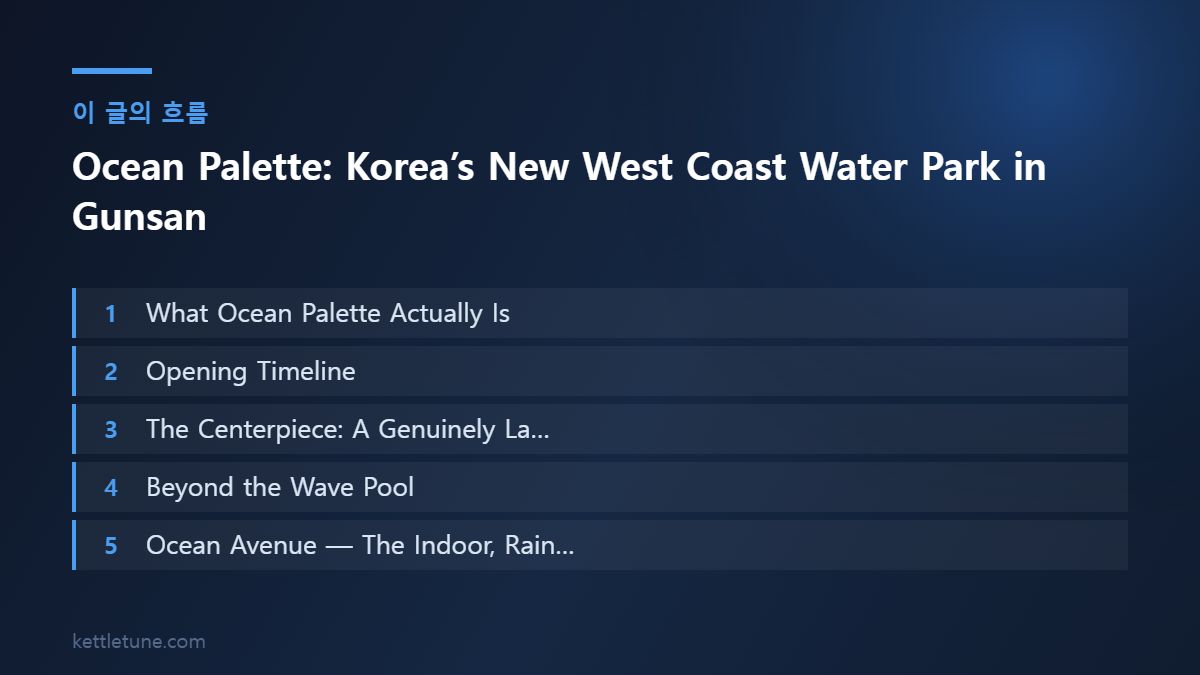
    Ocean Palette: Korea’s Ne… — 이 글의 흐름아래 순서대로 읽으시면 이해가 빠릅니다1What Ocean Palette Actually Is2Opening Timeline3The Centerpiece: A Genuinely Larg…4Beyond the Wave Pool5Ocean Avenue — The Indoor, Rain-o…6Where to Stay: Island-Hopping Is …본문 구성 기준

    What Ocean Palette Actually Is

    💡 A government-backed development project, years in the making

    Ocean Palette was included in a 2018 Ministry of Oceans and Fisheries infrastructure plan, developed as part of an economic revitalization initiative tied to Gunsan’s designation as an employment and industrial crisis region. The project cost roughly ₩42.8 billion (about $31 million) to build across 64,000 square meters on Munyeo Island.

    Opening Timeline

    ✅ Trial run in early July, full opening on the 10th
    A trial operation period began July 3, 2026, allowing the city to test facilities and address issues before the official grand opening on July 10, 2026. Annual visitor projections are around 170,000.

    The Centerpiece: A Genuinely Large Wave Pool

    💡 55m wide, 60m long, waves up to 3m high

    The signature attraction is a wave pool measuring 55m wide by 60m long, capable of generating waves up to 3 meters high across 8 different wave programs — a scale that’s genuinely surprising for a West Coast facility, given the region isn’t typically associated with dramatic surf conditions.

    Beyond the Wave Pool

    ✅ A full water leisure complex, not just one attraction

    🏄 Surf zone
    🤿 5m-deep diving pool
    🏊 Infinity pool
    ⛺ 100 cabanas
    🌲 Forest camping ground
    🚣 Leisure lake
    🐟 Ocean Avenue (marine exhibit hall + aqua cafe)

    Ocean Avenue — The Indoor, Rain-or-Shine Option

    💡 An educational marine exhibit with an aquarium cafe upstairs

    The ground floor houses a hands-on marine exhibit where visitors can observe — and in some programs, touch and feed — marine life not commonly seen up close, an eco-friendly experience geared especially toward kids. Upstairs, an aquarium cafe with a large tank lets you enjoy a drink while watching the underwater scenery.

    Where to Stay: Island-Hopping Is Part of the Plan

    ✅ The park itself is camping/car-camping focused — lodging is on nearby islands

    🏝️ Munyeo Island — closest, about a 5-minute drive, most convenient
    🏖️ Seonyudo Island — highest concentration of lodging, restaurants, and cafes; generally considered the most satisfying base
    🌊 Jangjado & Daejangdo Islands — quieter atmosphere, good for those wanting a calmer stay

    All these islands are bridge-connected to Munyeo, making car travel between them straightforward.

    Book Early for Peak Season

    ⚠️ Ocean-view rooms sell out fast in July-August
    Accommodations during peak summer season (July-August) can book out 1-2 weeks in advance, with ocean-view rooms selling especially quickly. When choosing lodging, factor in travel time to Ocean Palette itself as a key criterion.

    Extend the Trip: Nearby Island Attractions

    ✅ A natural add-on for a multi-day itinerary
    After a day at the water park, staying overnight at an ocean-view pension on Munyeo or Seonyudo to catch the sunset is a commonly recommended pairing, along with a stroll along the round pebble beach in front of the complex. The next morning, Jangjado’s skywalk and the Daejangbong ridge trail offer views combining the West Coast’s reed landscapes with emerald-toned water.

    Check Before You Go

    ⚠️ As a newly opened facility, schedules can shift
    Since opening, there have been notices about traffic control for a nearby triathlon event and occasional closure days with free admission promotions. Check the official site (oceanpalette.kr) or Gunsan city tourism department for current operating hours before planning your visit.

    Bottom Line

    Ocean Palette is a genuinely large-scale addition to Korea’s West Coast, built around a wave pool that rivals facilities usually associated with the East Coast or major domestic water parks. As a brand-new attraction, it’s worth booking accommodation early during peak summer, and pairing your visit with the nearby Gogunsan Islands for a multi-day trip rather than treating it as a single-day stop.

    Frequently Asked Questions

    Q: Can I stay overnight at Ocean Palette itself?
    On-site accommodation is limited to camping and car-camping style options. Standard lodging is available on nearby Munyeo, Seonyudo, Jangjado, and Daejangdo islands, all connected by bridge.

    Q: How much does admission cost?
    Pricing for cabanas and other facilities varies by season, so checking the official rate table before your visit is recommended.

    Q: Is there anything to do if the weather is bad?
    Yes — Ocean Avenue’s indoor marine exhibit and aqua cafe operate year-round regardless of weather, making it a solid rain-day option within the complex.

    Ocean Palette: Korea’s New West Coast Water Park in Gunsan 핵심 흐름 요약: What Ocean Palette Actually Is, Opening Timeline, The Centerpiece: A Genuinely La…

    References

    Related Reads

  • Yangyang, Korea: Inside the Country’s Surfing Capital

    Yangyang, Korea: Inside the Country’s Surfing Capital

    Ask any surfer who’s spent time in Korea where to go, and the answer is almost always the same: Yangyang. What used to be a quiet stretch of East Coast fishing towns has become the country’s clear surfing hub — here’s what you actually need to know before you go.

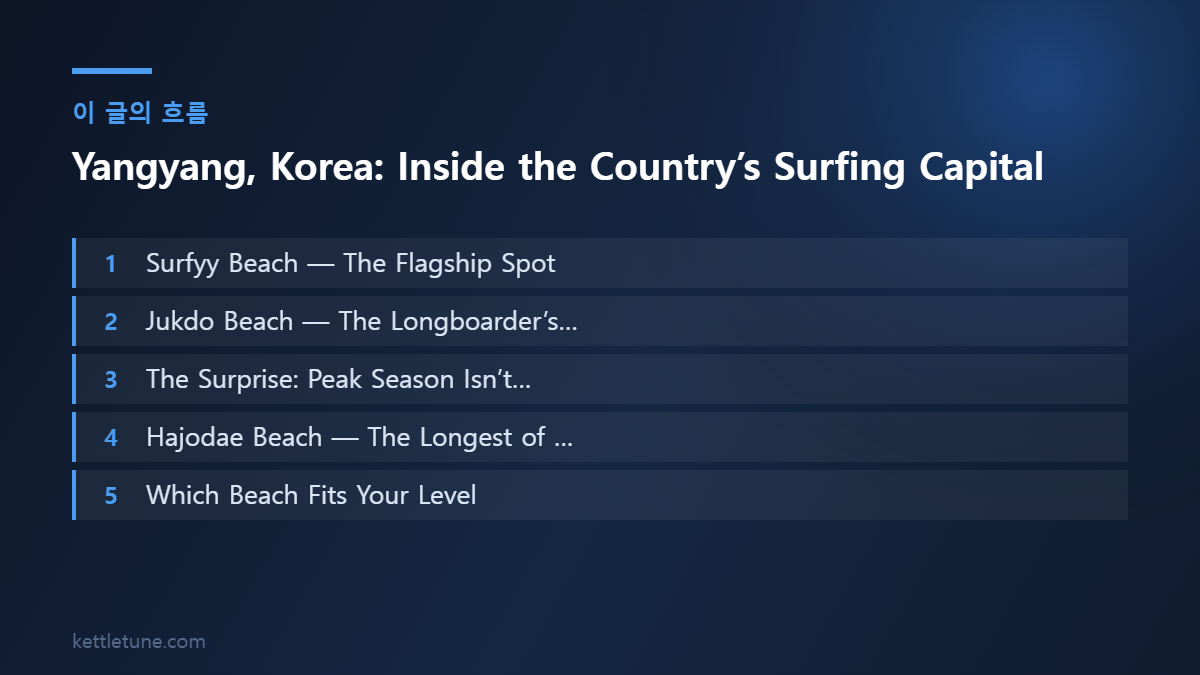
    Yangyang, Korea: Inside t… — 이 글의 흐름아래 순서대로 읽으시면 이해가 빠릅니다1Surfyy Beach — The Flagship Spot2Jukdo Beach — The Longboarder’s B…3The Surprise: Peak Season Isn’t S…4Hajodae Beach — The Longest of th…5Which Beach Fits Your Level6Parking Reality Check본문 구성 기준

    Surfyy Beach — The Flagship Spot

    💡 The most talked-about surf destination in the country

    📍 119 Hajodae-haeanngil, Hyeonbuk-myeon, Yangyang · Open 9:00 AM – 2:00 AM
    Consistently cited as Korea’s hottest surf travel destination, with its own large dedicated parking lot (about $4/day). Arrive before 9 AM and free street parking is sometimes available; after that, plan on the paid lot.

    Jukdo Beach — The Longboarder’s Break

    ✅ Small, mellow, and shaped by a rocky headland
    Small and gentle, with a rocky headland that helps shape even small swells into rideable form — a favorite among longboarders. Weekend lineups can get crowded, but the overall vibe stays friendly. Ocean-view cafes with a surf-shop aesthetic line the beachfront, worth a browse even between sessions.

    The Surprise: Peak Season Isn’t Summer

    ⚠️ The best swells actually arrive in fall and winter
    If you’re chasing genuinely good waves rather than just a beach vacation with a surf lesson attached, know that Yangyang’s best swells typically arrive in fall and winter, not summer. Summer remains ideal for learning and casual beach time, but serious surfers often plan trips around the shoulder seasons instead.

    Hajodae Beach — The Longest of the Four

    ✅ About 1.5km, with the best tube shape on a fall swell
    A clean, wide stretch of beach with a relaxed atmosphere, ideal if you want to enjoy the water without the more crowded surf-specific breaks. When fall swells roll in, this spot is known for producing some of the best-shaped barrels among the four main beaches.

    Which Beach Fits Your Level

    BeachBest For
    Surfyy BeachBiggest scene, most consistent summer waves
    Jukdo BeachLongboarders, mellow small-swell days
    Ingu BeachBeginners — less commercialized, local surf schools bring first-timers here
    Hajodae BeachLongest stretch, best shape when fall swells arrive
    Yangyang, Korea: Inside t… — Best ForBeachBest ForSurfyy BeachBiggest scene, most con…Jukdo BeachLongboarders, mellow sm…Ingu BeachBeginners — less commer…Hajodae BeachLongest stretch, best s…본문 표 데이터 기준

    Parking Reality Check

    ⚠️ Every beach charges for parking, all day
    Expect ₩3,000-5,000 (roughly $2-4) flat-rate parking at every beach in the area. Surfyy Beach’s own large lot runs about $4. If you arrive before 9 AM, free street parking is sometimes available — after that, budget for the paid lot.

    Naksansa Temple — Sunrise Worth Waking Up For

    ✅ Opens at 4 AM in summer for sunrise visitors
    Known for genuinely spectacular sunrises, this temple opens as early as 4 AM during summer specifically to accommodate visitors coming for the sunrise. It sits near Hajodae, making it easy to pair with a beach morning.

    Try the Local Specialty: Pine Mushroom Porridge

    ✅ One of Korea’s best pine mushroom regions
    Yangyang’s food scene centers on seafood, but the regional specialty worth seeking out is songi-juk (pine mushroom porridge) — Yangyang is one of Korea’s top pine mushroom-producing regions, and a bowl typically runs $11-15.

    Where to Stay

    ✅ Three tiers, depending on your budget and priorities

    🏄 Surf hostels — small, board-friendly, near the beach; dorms or basic private rooms, roughly $30-50
    🏡 Mid-range guesthouses/pensions — near Jukdo and Ingu, roughly $65-110
    🏢 Resorts — options like Sol Beach Yangyang, from roughly $160 in low season, $325+ in peak season

    Sample 1-Day Surf Itinerary

    💡 Day trip from Seoul, timed around a surf session

    Depart Seoul early morning, arrive Yangyang by mid-morning. Rent gear at Surfyy Beach or a Jukdo surf shop, surf until early afternoon, lunch on the beach, then head to nearby Sokcho’s Daepo Port for fresh raw fish before heading back.

    Snorkeling Is an Underrated Option Too

    ✅ Clear water beyond the surf breaks
    Yangyang isn’t just for surfers — Hajodae Beach works well for family-friendly snorkeling, while Namae Beach suits those looking for a wider mix of water activities. Sujanghang Marina also runs free marine leisure programs (cruise yachting, SUP, dinghy sailing lessons) from May through November.

    Bottom Line

    If you want the biggest surf scene with the most reliable infrastructure, head to Surfyy Beach. If you’re chasing genuinely good waves rather than a beach vacation, plan around fall or winter rather than peak summer. Either way, budget for parking everywhere, and don’t skip Naksansa’s sunrise if you’re an early riser.

    Frequently Asked Questions

    Q: Is Yangyang good for complete beginners?
    Yes — Ingu Beach is specifically favored by local surf schools for first-timers, and Jukdo’s gentle, small-swell conditions also work well for beginners.

    Q: When is the actual best time for experienced surfers?
    Fall and winter typically bring the best swells, despite summer being the more popular tourist season for casual beach visits.

    Q: How far is Yangyang from Seoul?
    Roughly 2-3 hours by car, making it a feasible day trip, though an overnight stay lets you fit in more surf sessions and less rushed sightseeing.

    Yangyang, Korea: Inside the Country’s Surfing Capital 핵심 흐름 요약: Surfyy Beach — The Flagship Spot, Jukdo Beach — The Longboarder’s…, The Surprise: Peak Season Isn’t…

    References

    Related Reads

  • Sokcho Travel Guide: Seoraksan National Park and the New Coastal Boardwalk

    Sokcho Travel Guide: Seoraksan National Park and the New Coastal Boardwalk

    On Korea’s northeastern coast, Sokcho pairs one of the country’s most dramatic national parks with a genuine East Sea beach town feel. Here’s what to prioritize, including a newly opened boardwalk that’s quickly become one of the region’s most-visited additions.

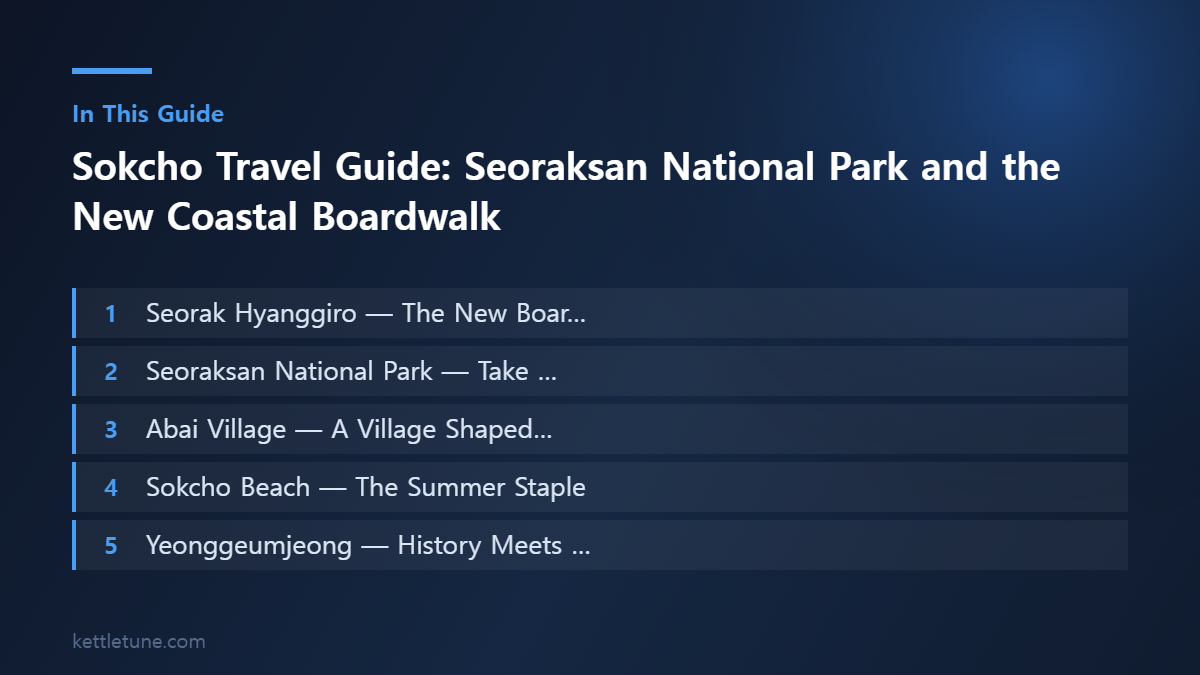
    Sokcho Travel Guide: Seor… — 이 글의 흐름아래 순서대로 읽으시면 이해가 빠릅니다1Seorak Hyanggiro — The New Boardw…2Seoraksan National Park — Take th…3Abai Village — A Village Shaped b…4Sokcho Beach — The Summer Staple5Yeonggeumjeong — History Meets Art6Bit-ui Bada Sokcho — The Nighttim…본문 구성 기준

    Seorak Hyanggiro — The New Boardwalk Everyone’s Talking About

    💡 Over 350,000 visitors in its first year

    A 2.7km looped walking path featuring a suspension bridge and skywalk sections, this recently opened trail has drawn over 350,000 visitors within a year of opening, quickly establishing itself as a major new attraction in the region.

    Seoraksan National Park — Take the Cable Car

    💡 Waterfalls, granite peaks, and a cable car shortcut

    📍 1137 Seoraksan-ro, Seorak-dong, Sokcho
    Hiking routes here pass Biryong Falls, Ulsanbawi Rock, and Geumgang Cave, offering a range of trails through dramatic natural scenery. If a full hike feels like too much, the cable car provides a comfortable alternative — the ride itself passes through dense pine forest and jagged rock formations, with panoramic peak, forest, and sky views from the summit observation deck. The cable car station also has a small cafe and exhibit space.

    Abai Village — A Village Shaped by Displacement History

    ✅ A cultural destination with real historical weight
    Formed by refugees from Hamgyong province who settled here, Abai Village is one of Sokcho’s key cultural destinations, recommended as part of the region’s official tourism promotions.

    Sokcho Beach — The Summer Staple

    ✅ The area’s primary summer swimming destination
    Sokcho’s representative beach and one of the busiest summer swimming spots on this stretch of coast.

    Yeonggeumjeong — History Meets Art

    ✅ A historic site with an attached exhibit hall
    📍 43 Yeonggeumjeong-ro, Dongmyeong-dong, Sokcho
    A site with a long history, paired with a hall exhibiting the region’s history, culture, and artwork.

    Bit-ui Bada Sokcho — The Nighttime Spot

    💡 A recommended nighttime attraction
    Known as a nighttime viewing spot, this location has also been featured among the region’s officially recommended tourist attractions.

    Sokcho’s Signature Dish: Naengmyeon

    ✅ Buckwheat country makes for the best cold noodles
    Naengmyeon (cold buckwheat noodles) is essential Sokcho eating — Gangwon province is ideal buckwheat-growing terrain, and this noodle dish is especially well-known along the whole east coast, Sokcho included.

    The Efficient Local Route

    ✅ A route locals actually recommend
    Local guides suggest building your itinerary around the squid market, Yeonggeumjeong, Abai Village, the Daepo Port observation deck, and Sokcho Tourist Fish Market for the most time-efficient route through town.

    Planning Your Days

    ✅ A day-and-a-half covers the essentials, two-plus nights for a relaxed pace
    A 1-night trip covers the essential sights comfortably; 2 nights gives you room to enjoy things at a more relaxed pace. While spring (April-June) and fall (September-October) are often cited as the ideal travel windows, summer brings its own appeal with beach swimming and outdoor spots like Seorak Hyanggiro in full use.

    Getting Around

    ✅ Buses run more reliably than you’d expect
    Intercity bus is the recommended way to reach Sokcho, and once there, local bus intervals are well-managed enough that a map app makes getting around easy without a car.

    Frequently Asked Questions

    Q: Do I need to book the Seoraksan cable car in advance?
    During peak season, waits can be long, so arriving early or checking the official site for reservation options in advance is worth doing.

    Q: Is Seorak Hyanggiro suitable for kids?
    As a looped walking trail, it’s generally considered manageable for family groups.

    Q: What’s the best season to visit Sokcho?
    Local guides often cite spring and fall as ideal, but summer has its own appeal for beach access and outdoor attractions like Seorak Hyanggiro, each season offering a different character.

    Sokcho Travel Guide: Seoraksan National Park and the New Coa 핵심 흐름 요약: Seorak Hyanggiro — The New Boar…, Seoraksan National Park — Take …, Abai Village — A Village Shaped…

    References

    Related Reads