
Getting around like a local starts with knowing which app to open ⓒ Unsplash
There’s a particular kind of travel frustration that hits the moment you land in an unfamiliar city and realize you have no idea how to get from the airport to your hotel without getting taken advantage of. Unofficial taxis, fixed-price “tourist rates,” and drivers who conveniently don’t have change — it’s a story every seasoned traveler has lived at least once.
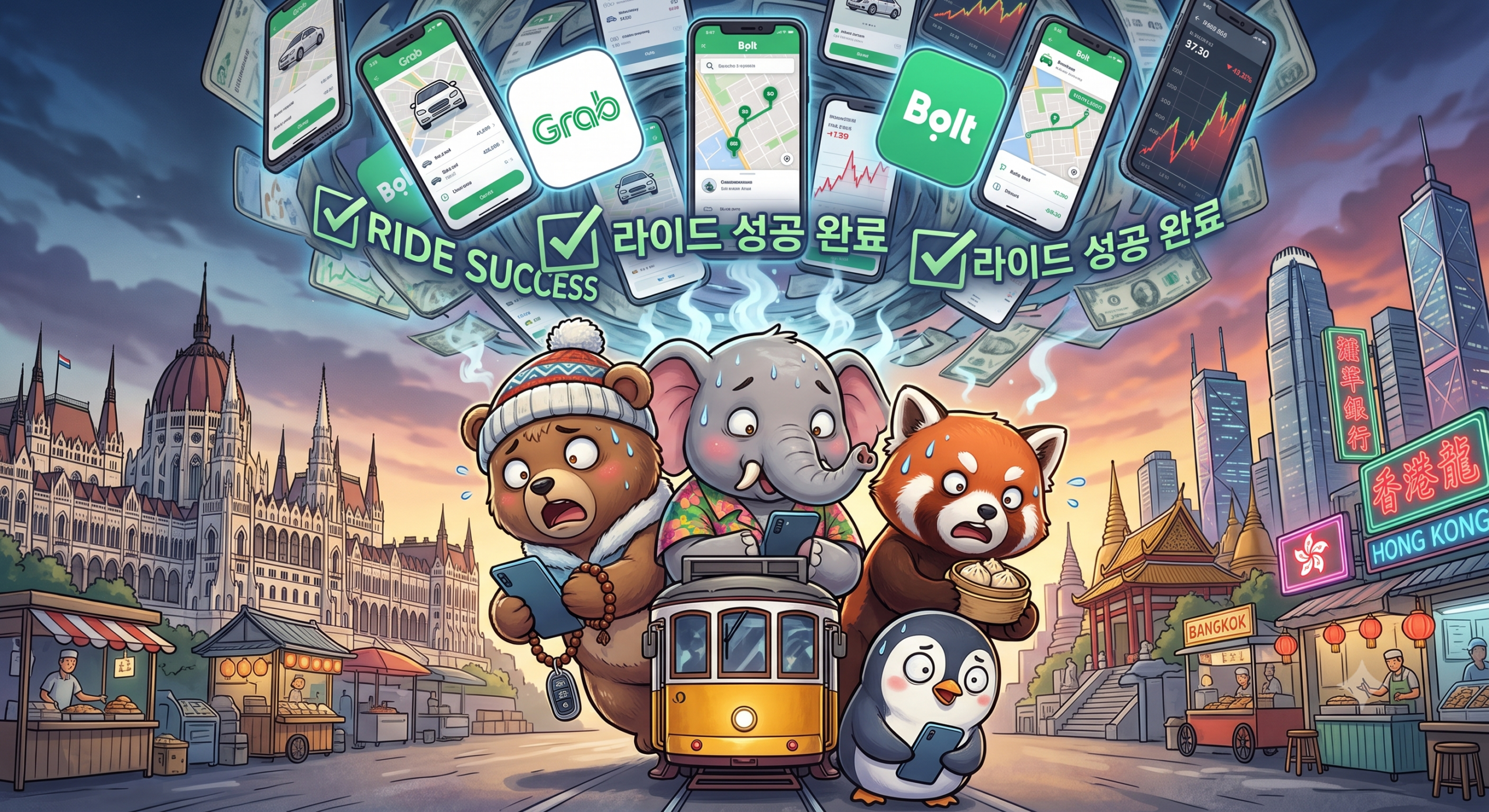
The good news is that ride-hailing apps have fundamentally changed this equation. When used correctly, they eliminate price negotiation, provide route transparency, offer driver accountability, and give you a digital record of every trip. But they only work when you know which app to use where, and what the local quirks are — which is exactly what this guide covers.
1. Budapest, Hungary: Why Bolt Is the Only Answer

Budapest’s transport mix rewards the prepared traveler ⓒ Unsplash
🟡 App to Use: Bolt (formerly Taxify)
Bolt is an Estonian-founded ride-hailing platform that has become the dominant app-based transport option across Central and Eastern Europe. In Budapest specifically, it has a significant driver network and consistently undercuts traditional taxi pricing.
Practical Bolt Tips for Budapest
📱 Download before you land — Set up payment in advance. Adding a card at the airport on slow WiFi is not fun.
💶 Currency note — Hungary uses the Hungarian Forint (HUF), not euros. Bolt charges in HUF. The app will show the estimate clearly before you confirm.
📍 Airport pickups — At Budapest Ferenc Liszt International Airport (BUD), Bolt pickups happen at the designated rideshare zones on Level 0 of the terminal. Follow the app’s pickup pin carefully — drivers can’t always stop where you’re standing.
🚫 Avoid unmarked taxis — Budapest has a known history of overcharging tourists via unmarked or unofficial cabs, particularly outside the main train stations and popular nightlife areas. Always use Bolt or the official Főtaxi app (yellow cabs with meters).
🕐 Surge pricing — Like all ride-hailing apps, Bolt surges during peak hours and bad weather. If the price looks high, wait 5–10 minutes or walk a block before requesting.
When to Skip Bolt in Budapest
Budapest’s public transport system — run by BKK — is excellent and remarkably affordable. The metro, trams, and buses cover most tourist destinations efficiently. For short hops within the inner city, a 24-hour or 72-hour BKK travel card will cost far less than multiple Bolt rides and gives unlimited access to the entire network. Use Bolt for airport transfers, late-night returns, or trips to neighborhoods not well-served by transit.
2. Bangkok, Thailand: Mastering Grab (And When to Use GrabBike)
🟢 App to Use: Grab (Primary) + Bolt (Secondary)
Grab is Southeast Asia’s dominant super-app, and in Bangkok it offers multiple transport modes — standard car (JustGrab), motorcycle taxi (GrabBike), van (GrabCar Plus), and more. Understanding which mode to use when is the difference between moving through Bangkok efficiently and sitting in traffic watching your time disappear.
The Bangkok Traffic Reality
Bangkok’s traffic is not a minor inconvenience — it’s a genuine urban mobility challenge that shapes how you should plan every journey. Distances that look short on a map can take 45–60 minutes by car during peak hours (roughly 7–9am and 5–8pm on weekdays). The BTS Skytrain and MRT subway exist precisely because road transport alone cannot handle the city’s demand.
| Grab Mode | Best Use Case | Peak Hour Performance |
|---|---|---|
| JustGrab (car) | Airport, long distances, luggage | Slow — avoid for short hops |
| GrabBike | Short distances, last-mile to BTS | Excellent — motorcycles filter through traffic |
| GrabTaxi | Metered taxi with Grab accountability | Similar to JustGrab |
🏍️ GrabBike is underutilized by tourists — If you’re alone, carrying only a small bag, and traveling a short distance during peak hours, a GrabBike will almost always be faster than a car. Helmets are provided by the driver (required by law). The price is a fraction of a car ride.
📍 BTS + GrabBike combination — For many journeys, the optimal strategy is: take BTS/MRT to the nearest station, then GrabBike the last 1–3km. This beats both full-car and full-transit options in most scenarios.
🛬 Suvarnabhumi Airport (BKK) — Grab pickups are on Level 1, public pickup zone. Expect a short walk from arrivals. Ride-hailing is officially permitted and the pricing is transparent — typically 250–400 THB to central Bangkok depending on destination and time of day.
💵 Cash vs card — Grab in Thailand accepts both. Having a small amount of Thai Baht cash is still useful for GrabBike drivers who may prefer it.
Bangkok’s official metered taxis (pink and green, or yellow and green) are a legitimate alternative when Grab surge pricing is high. The key rule: always insist the driver uses the meter (“meter, please” — “mit-ter duay, krap/ka”). If they refuse, get out and find another. The airport taxi queue uses meters by law.
3. Hong Kong: A Different Problem Entirely
🔴 App to Use: Uber (limited) + HKTaxi + Focus on Public Transit
Hong Kong is a special case. The city has one of the best public transit systems in the world — the MTR (Mass Transit Railway) is fast, clean, frequent, and covers virtually every area tourists visit. Ride-hailing in the traditional sense is more limited here than in most major Asian cities.
The Hong Kong Transport Reality
Uber operates in Hong Kong but occupies a legally ambiguous space — drivers use private vehicles and technically require a hire car permit. This means availability is lower than in other cities, prices are higher, and the service is less reliable as a primary option.
🚇 Get an Octopus Card immediately — The Octopus card works on MTR, buses, trams, ferries, and even some convenience stores. Available at any MTR station for a small deposit. This is your primary transport tool.
🚕 Official red taxis — Hong Kong’s red taxis (urban areas) are metered, regulated, and generally trustworthy. They accept Octopus card for payment. The HKTaxi app lets you book ahead with price transparency.
🎢 Disneyland Resort area — Disney Resort is served directly by the MTR Disneyland Resort Line from Sunny Bay station. No need for taxis or ride-hailing — it’s the most efficient connection possible. From Kowloon or Hong Kong Island, take the MTR to Sunny Bay and transfer.
⛴️ Star Ferry — For crossing between Kowloon and Hong Kong Island, the Star Ferry is both the most scenic and (at a few HKD) the most economical option. Don’t take a taxi for this crossing.
4. Universal Ride-Hailing Rules That Apply Everywhere
| Rule | Why It Matters |
|---|---|
| Download and set up payment before arrival | Airport WiFi and SIM card stress makes in-app setup frustrating |
| Screenshot your booking confirmation | If the app crashes or connection drops, you have the driver details |
| Verify the license plate before getting in | Fake drivers at popular pickup spots are a real risk in some cities |
| Always rate your driver | Maintains platform accountability and helps other travelers |
| Know the local emergency number | In-app support is slow — local emergency numbers are instant |
Frequently Asked Questions
Q. Do these apps work with international credit cards?
Bolt (Europe) works well with international Visa and Mastercard. Grab (Southeast Asia) accepts international cards but can occasionally have processing issues — having a local payment method or cash backup is wise. For Hong Kong, Octopus card is the primary tool; international cards work on taxis.
Q. Is it safe to use GrabBike in Bangkok?
GrabBike is widely used by locals and expats in Bangkok. The main considerations are wearing the helmet provided, holding on securely, and accepting that traffic in Bangkok is chaotic. For those comfortable with motorcycle travel, it’s an excellent option. For those not, stick to JustGrab cars.
Q. What’s the best way to get from Bangkok’s Suvarnabhumi Airport to the city center?
The Airport Rail Link (Suvarnabhumi Airport Rail Link) runs directly to Phaya Thai Station in central Bangkok in about 30 minutes for a fraction of the taxi cost. It’s the most efficient option during rush hours. Grab cars are preferable for direct hotel delivery or when traveling with significant luggage.
Q. Does Bolt work in Asian cities outside Hungary?
Bolt operates in approximately 45 countries, with strongest penetration in Africa, Eastern Europe, and parts of Asia (particularly certain markets in Nigeria, Kenya, and Estonia’s neighbors). In Bangkok and Hong Kong, Grab and local alternatives are more established. Always check Bolt’s coverage map before relying on it as your primary option in a new destination.
답글 남기기